 Skip-the-line available
 When is the Siena Cathedral floor uncovered in 2026, and which panels should you look for?
The marble floor is on full view for two windows in 2026. Here are the dates, the Sunday changes and the panels worth finding.
In 2026 the Siena Cathedral floor is uncovered from 27 June to 31 July and again from 18 August to 15 November. If you are reading this in October, the second window is open now and runs until mid-November. For the rest of the year most of the floor sits under a protective covering, so these weeks are your chance to see all 56 inlaid marble panels at once. This guide gives you the dates and opening hours, explains why the floor is covered, and shows how the panels were made. It then walks you through the key scenes in the order you meet them, from the entrance to the altar. Finally, it covers the Sunday changes during the uncovering and what the Porta del Cielo roof walk adds to the visit.
When is the Siena Cathedral floor uncovered in 2026?
The Opera della Metropolitana di Siena, which runs the Cathedral, lists two uncovering windows for 2026. The first ran from 27 June to 31 July. The second runs from 18 August to 15 November. Between the two windows, from 1 to 17 August, the floor goes back under its covering. If your trip falls in early August, check your dates against both windows before you plan the day around the floor.
Opening hours change partway through the second window. From 18 August to 31 October the Cathedral opens 10:00 to 19:00 from Monday to Saturday. From 1 to 15 November it switches to reduced hours, 10:30 to 17:30. Last admission is 30 minutes before closing in both periods. The operator also notes that times can change for religious services, so check the hours again close to your visit.
Admission is charged for the Cathedral while the floor is on view. Children up to 6 are free, added to your booking at no charge. The Cathedral entry is also part of the wider complex pass and the Gate of Heaven ticket, which bundles the roof walk with the Cathedral, the Piccolomini Library, the Museum, the Crypt and the Baptistery. Both of those combined tickets are valid for three consecutive days, which gives you room to come back to the floor on a quieter morning.
Why is the Siena Cathedral floor covered for most of the year?
The short reason is wear. A 2023 report on the uncovering described the floor as so fragile that it usually has to be covered to stop it being worn away. The Cathedral is a working church as well as a monument, and every visitor walks across the marble. Covering the panels outside the set windows keeps that foot traffic off the most delicate scenes.
Wear has shaped this floor for centuries. The Italian encyclopedia entry on the Cathedral notes that almost every scene has been restored over time to repair wear, and that some were remade from scratch while keeping their old look. The She-Wolf panel is one example. It dates from the 14th century but was heavily restored in 1865, and the operator's ground plan now credits it to the restorer.
Outside the uncovering windows the floor is not entirely hidden. The English encyclopedia entry explains that the panels near the altar are covered, while some near the entrance can still be seen. That means a winter visit still shows you a little of the marble. To see the hexagon under the dome and the large Beccafumi scenes by the altar, though, you need to come during one of the 2026 windows.
How were the 56 floor panels made?
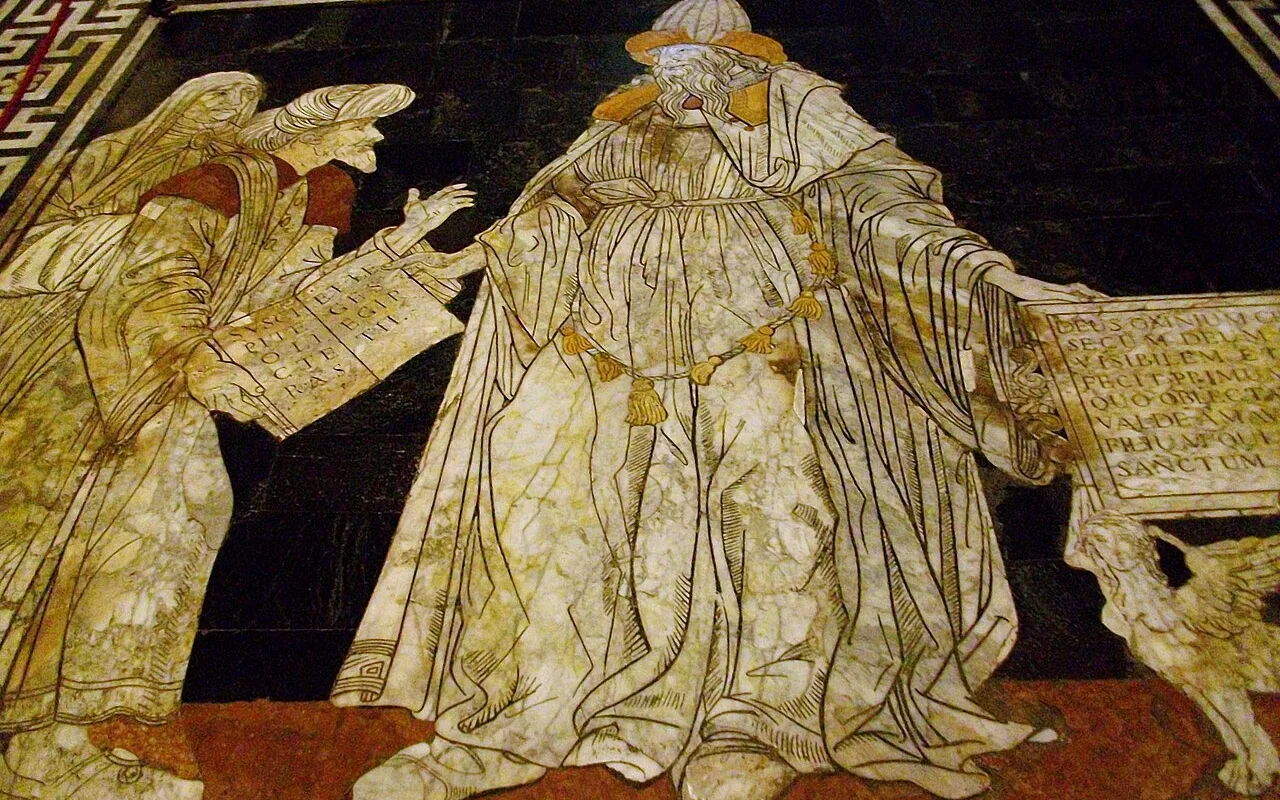
The floor took shape over a long programme of work between the 14th and 19th centuries. Leading artists supplied preparatory cartoons, which are full-size drawings, for the 56 inlay panels. According to the operator, all of them were Sienese except one: the Umbrian painter Pinturicchio, who designed the Mount of Wisdom in 1505. Giorgio Vasari called it the most beautiful, largest and most magnificent floor ever made.
The first technique is called graffito. Craftsmen traced the design onto white marble slabs with a chisel and a drill. They then filled the cut lines with black stucco, so the drawing shows up dark against the pale stone. Look closely at the older panels and you can see this line-drawing quality. The figures read almost like an ink sketch laid into the stone.
The second technique is marble mosaic inlay. Here, pieces of coloured marble were cut and fitted together in the way a cabinet-maker fits wood veneers. The method started simple and grew more refined over the centuries. Domenico Beccafumi pushed it furthest. The operator says he managed to create light and shade with marble alone, and the English encyclopedia entry adds that he used different tones within a single piece of stone to model his figures.
Where is Pinturicchio's Mount of Wisdom?
Keep going towards the dome and you meet the Allegory of the Mount of Wisdom, the fifth panel on the operator's ground plan. Pinturicchio designed it in 1505. That date falls in the same years he was painting the frescoes of the Piccolomini Library in this Cathedral. It is also the one panel whose designer was not Sienese, which makes it a useful marker as you walk.
The operator sums up the message of the whole floor as a constant invitation to embrace Wisdom, and this panel carries that idea in its very name. It sits at a turning point in the floor. Behind you are Hermes, the Sibyls and the She-Wolf, all drawn from the classical world. Ahead, under the dome and towards the altar, the scenes come from the Bible. Pause here before you reach the crossing and look both ways.
If you have the Gate of Heaven ticket or the complex pass, it is worth pairing this panel with the Piccolomini Library. Pinturicchio painted the library's ten scenes from the life of Pope Pius II between 1502 and 1507. Seeing his floor design and his frescoes on the same visit gives you two sides of the same painter within a few metres of each other.
What is under the dome and near the altar?
The nave and aisles show the classical and pagan world. Once you reach the transept and chancel, the subject changes to the story of the people of Israel and the promise of salvation. The operator points out a detail that is easy to miss: Christ is never shown anywhere on the floor. He is understood to be present on the altar, which is where the whole sequence of panels leads.
Directly under the dome lies the large hexagon of Stories from the Life of Elijah and Ahab. It is made of smaller hexagons and diamond-shaped panels. Domenico Beccafumi designed the upper part between 1519 and 1524, according to the English encyclopedia entry. The lower part was not completed until 1878, by Alessandro Franchi. Stand at the edge and compare the two halves. The difference in hand is part of the interest.
Closer to the altar are more Beccafumi panels: Moses Striking Water from the Rock, Moses on Mount Sinai and the Sacrifice of Isaac. Moses Striking Water from the Rock is a frieze about eight metres long, finished in 1525. The Sinai panel followed between 1525 and 1529 and runs its scenes together in one large field. These are the panels where his light-and-shade technique is clearest, so look for the modelled faces and folds of cloth.
One panel in this area breaks the pattern. Matteo di Giovanni's Slaughter of the Innocents is the only scene in the transept and chancel not taken from the Old Testament. It follows the account in the Gospel of Matthew. The operator notes that the violence seems to play out right under the viewer's eyes. If you are visiting with children, you may want to look at it first yourself and decide how close to bring them.
How does Sunday opening change while the floor is on view?
For most of the year the Cathedral opens to visitors only on Sunday afternoons, from 13:30. During the uncovering this changes. Sunday Mass moves out of the Cathedral to the church of Santissima Annunziata, and the Cathedral opens to visitors on Sunday mornings. From 18 August to 31 October, Sunday and holiday hours are 9:30 to 18:00. The roof walk follows the Cathedral's hours, so on a floor-season Sunday the first roof departures also start at 9:30.
From 1 to 15 November, the last part of the window, the reduced hours apply. The operator's pages list Sunday and holiday opening from 10:00 on one page and from 9:30 on the Gate of Heaven page, with closing at 17:30. If you are planning a Sunday visit in early November, aim for later in the morning rather than right at opening, and leave yourself room either side.
If you want to attend Mass during the uncovering, go to Santissima Annunziata rather than the Cathedral. The cathedral lists a weekday Mass there at 9:30, with Sunday and holiday times also posted. The Cathedral itself always stays open to the faithful for prayer through the Door of Forgiveness. Sunday mornings in floor season are a rare chance to see the panels before the afternoon crowds, so they tend to book up.
Can you see the floor from the Porta del Cielo roof walk?
The Porta del Cielo, or Gate of Heaven, takes you into the roof spaces above the blue, star-painted vaults. The operator describes walking above the nave with views both inside and outside the Cathedral. The route, as described when it opened in 2013, takes you along internal galleries that look down into the nave towards the high altar and the copy of Duccio's round window. It ends on a gallery on the inside of the façade.
So yes, the roof walk looks down into the nave, and the floor is down there. What it gives you is the overall layout: the long run of the nave, the striped columns and the floor between them. What it cannot give you is the detail. To read the faces of the Sibyls or the light and shade in Beccafumi's Moses, you need to stand at floor level and look down. The two views work best together.
A practical order is to do the roof walk first, then the floor. The roof visit lasts 30 minutes, is led by Cathedral staff and takes 18 people per departure. You meet at the Cathedral's main entrance, in the priority queue, at least 20 minutes before your time. The operator gives no refund for the roof ascent if you arrive late. Backpacks and large bags are not admitted, and closed-toe, non-slip shoes are advised.
Floor season is also roof season, and the two together draw a crowd. On 1 October, the 9:30 and 10:00 roof departures for Sunday 4 October had already sold out, with only two places left at 12:30. If you want a morning slot while the floor is uncovered, book a few days ahead. We buy the official Gate of Heaven ticket for you, and your e-ticket arrives by email.
Frequently asked
What are the 2026 dates for the uncovered floor at Siena Cathedral?
The floor is uncovered from 27 June to 31 July and from 18 August to 15 November 2026. It is covered again from 1 to 17 August. Reduced opening hours apply from 1 November.
Why is the Siena Cathedral floor covered?
It is covered to protect it from wear. The marble is walked on by visitors every day, and the panels near the altar stay covered outside the set windows. Some panels near the entrance remain visible all year.
How many panels are on the Siena Cathedral floor?
There are 56 inlaid marble panels. They were made between the 14th and 19th centuries using two techniques: graffito, where lines cut into white marble are filled with black stucco, and marble mosaic inlay, where coloured pieces are fitted together.
Is Siena Cathedral open on Sunday mornings during the floor uncovering?
Yes. While the floor is on view, Sunday Mass moves to Santissima Annunziata and the Cathedral opens on Sundays from 9:30. Outside the uncovering, Sunday visiting starts at 13:30.
Can you see the floor from the Porta del Cielo roof walk?
You see it from above. The route looks down into the nave from internal galleries, which shows the layout of the floor. For detail on individual panels, walk the nave at floor level after your roof visit.
Do children pay to see the floor?
Children up to 6 are free, added to your booking at no charge. On the Gate of Heaven ticket, children aged 7 to 11 have a reduced ticket.