 Skip-the-line available
 Is the Porta del Cielo worth it? What you see on Siena Cathedral's rooftop walk
A plain look at the 30-minute escorted walk above Siena Cathedral's starred vaults, who it suits, and who should stay on the floor.
For most visitors, yes. The Porta del Cielo is a 30-minute walk through the roof spaces of Siena Cathedral, led by Cathedral staff, and it shows you the building from angles you cannot get anywhere else. You walk above the blue-and-gold starred vaults, look straight down into the black-and-white striped nave, and step out to views across the city's rooftops. It is not for everyone. The way up is a winding staircase, ceilings are low in places, and the operator advises against it for anyone with vertigo or a heart condition. This guide walks you through what the route shows, who will love it, who should skip it, and how to fit it into a three-day visit to the rest of the Cathedral complex.
What is the Porta del Cielo at Siena Cathedral?
Porta del Cielo means Gate of Heaven. It is the name the Opera della Metropolitana, the body that runs Siena Cathedral, gives to a visit through the attic and roof spaces above the nave. These rooms were never open to the general public before the walk was created. The name comes from Jacob's dream in Genesis, where he wakes and calls the place the house of God and the gate of heaven.
The visit lasts 30 minutes. A member of Cathedral staff goes with every group, for safety reasons, so you do not wander the roof on your own. The time on your ticket is the start of the roof walk, not a loose window. You meet at the main entrance of the Cathedral, in the priority queue, at least 20 minutes before your slot.
That meeting time matters. The operator gives no refund for the roof ascent if you arrive late at the meeting point. Build in a buffer, especially if you are coming from the station or from a car park outside the old town. Cars cannot reach the Cathedral directly, and Siena's streets climb, so give yourself more time than you think you need. Arriving early also gives you a few minutes to look at the façade before you go up past it.
What do you see inside the Cathedral from the roof walk?
The operator describes the walk simply: you go above the star-spangled vaults and get views both inside and outside the Cathedral. The detailed stop order in this guide comes from descriptions published when the route opened in 2013. Treat it as a picture of what the route takes you past rather than a fixed script, as the order today may differ.
The route takes you up past the two towers of the façade and then above the starred vaults of the right-hand aisle. Down on the floor, those vaults read as a painted blue sky scattered with gold stars. Up here you are walking on the other side of that sky. It is a strange and memorable switch of viewpoint, and it explains the gate-of-heaven name better than any sign could.
From internal galleries you then look down the length of the Cathedral towards the high altar. Above it sits the great round choir window. Duccio designed the original in 1288; the one in place now is a replica, and the original is kept in the Opera Museum. A room along the way also shows tools that were used to build the Cathedral, which gives you a sense of the labour behind the marble.
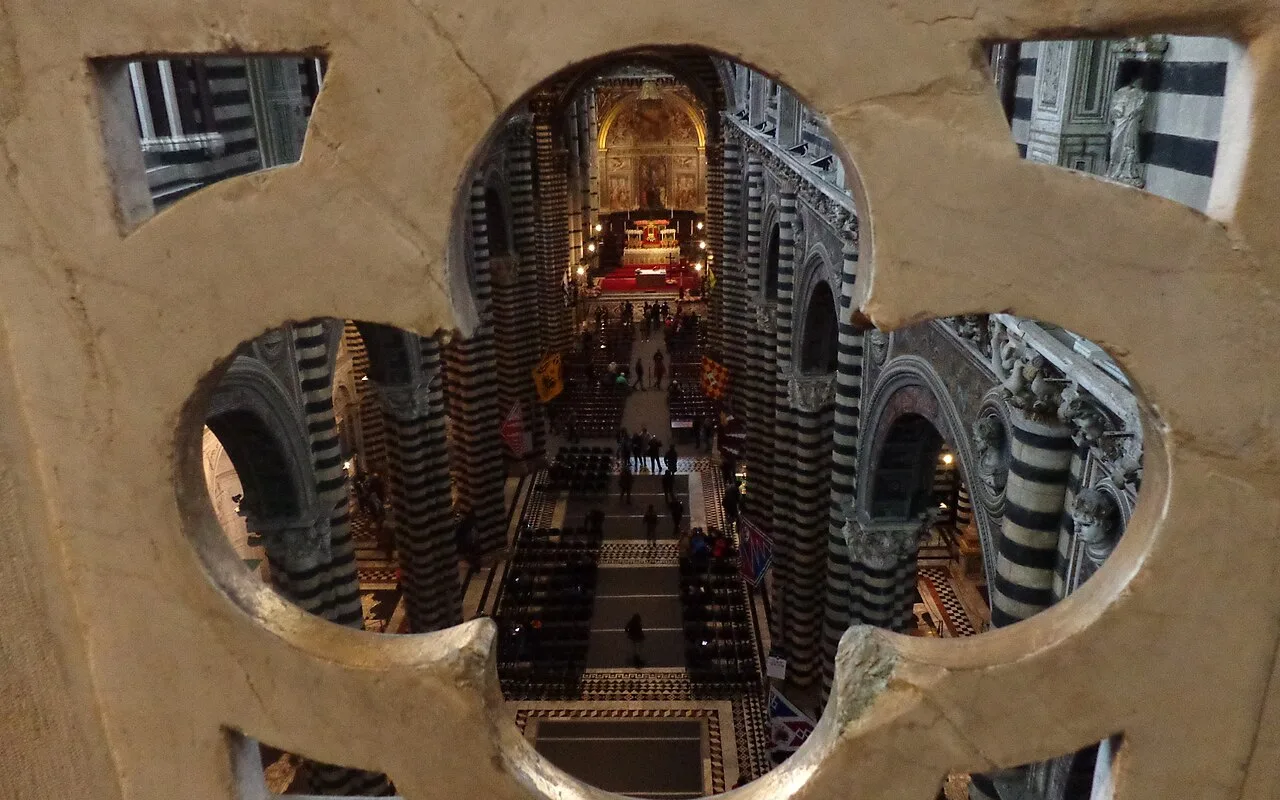
Most people come up for the view into the nave. The interior is banded in black and white marble, the colours of Siena's civic coat of arms, the balzana. From the floor the stripes climb every pier around you. From the galleries they run away in long rows towards the altar, and you see how the Latin cross, the crossing and the hexagonal base of the dome fit together as one plan.
What are the views over Siena from the roof?
After the inside views, the route takes you along the left side of the Cathedral, where openings look outward. On a clear day you look across to the Basilica of San Domenico, and beyond it to the Medici Fortress. Past them the Tuscan countryside stretches away from the edge of the city. It is a quieter, more framed view than you get from an open terrace. You see Siena's roofs in pieces, through stone openings, rather than as one sweep.
That is the difference from the Museum's Facciatone, the unfinished façade of the New Cathedral that was abandoned after the Black Death in 1348. Its terrace gives you an open panorama over the whole city. The roof walk gives you glimpses from inside the structure, with the building close around you. Both are worth seeing, and the combined ticket covers both, so you do not have to choose.
The route then brings you to the dome. Its inside is coffered and painted blue with gold stars, matching the vault you have just walked over, and outside it is crowned by Bernini's gilded lantern. From the dome gallery you are high above the crossing, where the nave and transepts meet, looking down on the space that is hardest to take in from the floor.
The walk ends on the gallery of the inner façade, the inside face of the front wall. This is where many people take their favourite picture. You stand at the entrance end, high up, and the whole nave stretches ahead of you towards the altar and the round choir window, stripe after stripe. From there a winding staircase brings you back down to the floor.
Who will love the Porta del Cielo, and who should skip it?
You will love it if you enjoy architecture, if you have seen a lot of Italian churches and want a new angle, or if you are a photographer who wants a view nobody gets from the floor. It also suits repeat visitors to Siena who have already seen the Cathedral once. Families can go too. Children up to 6 are free, added to your booking at no charge, and the rules ask you to hold younger children by the hand.
You should think twice if you suffer from vertigo or dizziness, or have a heart condition. The operator says the walk is not recommended for anyone in those groups, or for anyone not fit to climb to raised places. Ceilings and passageways are low in parts, so tall visitors need to watch their heads. This is a working roof space, not a museum gallery. If you are unsure, the floor visit and the Facciatone terrace give you plenty of Siena without the confined stairs.
Entry and exit are by a winding staircase. The operator does not say it outright, but that means the roof walk is not suitable for wheelchair users or anyone who cannot manage steep, turning stairs. The Cathedral itself does have a ramp on its left side, so a wheelchair user in your party can still visit the main church while others go up.
What to wear and what to leave behind
High heels are refused. Wear closed-toe shoes with anti-slip soles. The operator lists slippers, flip-flops, sandals, clogs and leather soles as unsuitable, so the smart shoes you packed for dinner are not the right choice. Trainers or walking shoes are ideal. If you are visiting in summer, swap the sandals for something enclosed before you leave your hotel. Being turned away at the stairs is a poor way to lose a slot you planned your day around.
Backpacks and large or bulky bags are not admitted on the roof. There is also no left-luggage deposit anywhere in the Cathedral complex, so you cannot hand a bag in on the day. Only umbrellas may be left at the foot of the staircase. Plan to carry a small bag, a pocket or nothing at all, and leave anything larger at your hotel.
Keep your phone, camera and glasses on a strap. The operator's rules ask for this at the lookouts, because anything dropped falls a long way. Smoking is banned at the lookout points. Keep both hands free on the stairs. The group moves on together, so frame your photo quickly and let the next person have the gap in the stone.
Why are there only 18 places on each walk?
Each departure takes 18 people. The galleries, stairs and passageways are narrow, a staff member has to keep the whole group in sight, and the roof was never designed for crowds. Keeping groups small is what makes the visit possible at all. It also keeps the walk calm, so you are not jostling for a turn at each opening. Eighteen people on a narrow gallery is already a full house.
The catch is that places go fast. Departures run roughly every half hour through the day, but with only 18 seats each, popular times fill well ahead. On one check on 1 October 2026, the 09:30 and 10:00 roof slots for the following Sunday were already full and the 12:30 slot had 2 places left. If you have a set day in Siena, book your roof time first and plan the rest around it.
The walk runs from 1 March to 6 January and follows the Cathedral's opening hours, with last admission 30 minutes before closing. It is closed from 7 January to the end of February. Times can change for religious services, so your confirmed slot is the one to trust. Your e-ticket arrives by email once your booking is done, ready to show at the entrance.
How the three-day ticket lets you see the rest of the complex
The roof walk is sold as part of a combined ticket. Along with the roof, it covers the Cathedral and the Piccolomini Library, the Opera Museum with the panorama from the New Cathedral façade, the Crypt and the Baptistery. The ticket is valid for three consecutive days, so you do not have to cram everything into one morning or rush the roof to fit the rest in.
A relaxed plan looks like this. Do the roof walk at your booked time, then spend an hour in the nave and the Piccolomini Library, where Pinturicchio painted ten scenes from the life of Pope Pius II between 1502 and 1507. On another day, see the Museum, climb to the Facciatone terrace, and visit the Crypt, which was found again in 1999, and the Baptistery with its font by Donatello, Jacopo della Quercia and Ghiberti.
Both tickets also include a free audio guide on your smartphone. Bring headphones so you can listen in the Cathedral without disturbing others. One practical note on access: the Museum, the Crypt and the Baptistery have no disabled access, while the Cathedral does. Plan your three days around what each member of your group can reach, and save the stair-free parts for anyone sitting out the roof.
Roof walk or the floor only: which should you choose?
Seeing the Cathedral from the floor gives you the close-up detail. You stand beside Nicola Pisano's pulpit from 1265 to 1268 and look up at the Piccolomini Altar with its four statues by the young Michelangelo. In 2026 the inlaid marble floor is uncovered from 27 June to 31 July and from 18 August to 15 November, and you walk among its 56 panels. None of that is on the roof walk. The floor is where the art is.
The roof walk adds the shape and scale of the building, plus the view out over Siena. It is the part that turns a beautiful church into a place you understand from end to end. If you have only a couple of hours, the floor alone is still a fine visit. If you have half a day or more and you are comfortable with stairs and heights, going up is worth it. Book the roof slot first, then let the three days do the rest.
Frequently asked
How long is the Porta del Cielo walk?
The roof walk lasts 30 minutes. A member of Cathedral staff accompanies every group. Meet at the Cathedral's main entrance, in the priority queue, at least 20 minutes before your slot.
Can I bring a backpack on the Siena Cathedral roof walk?
No. Backpacks and large or bulky bags are not admitted, and there is no luggage deposit anywhere in the Cathedral complex. Only umbrellas can be left at the foot of the staircase, so bring a small bag or none.
Can children do the Porta del Cielo?
Yes. Children up to 6 are free, added to your booking at no charge, and children aged 7 to 11 have their own ticket. The operator's rules ask you to hold children by the hand during the walk.
Is the Porta del Cielo wheelchair accessible?
No. You enter and leave the roof by a winding staircase, so the walk does not suit wheelchair users. The Cathedral itself has a ramp on its left side.
What happens if I arrive late for my roof slot?
The operator gives no refund for the roof ascent if you arrive late at the meeting point. Aim to reach the main entrance at least 20 minutes before your booked time.
Does the Porta del Cielo ticket include the Cathedral?
Yes. The combined ticket covers the roof walk, the Cathedral and Piccolomini Library, the Opera Museum with the Facciatone panorama, the Crypt and the Baptistery, valid for three consecutive days.