 Skip-the-line available
 How to see Siena's whole cathedral complex in one route
A top-to-bottom route through the Cathedral, Piccolomini Library, Crypt, Baptistery and Museo dell'Opera, with what to look for in each room.
Take the roof walk first if it is on your ticket, then work down through the Cathedral and the Piccolomini Library, below ground to the Crypt and the Baptistery, and finish at the Museo dell'Opera with its panorama. That order follows the building from the vaults to the foundations and saves the big view for last. The Opera della Metropolitana, which looks after the complex, says the OPA SI itinerary takes about two hours. The pass is valid for three consecutive days, so you can split it if you want a slower pace. This guide walks you room by room. For each stop it tells you what to look for and where it fits in the day. Names and dates come from the Opera's own pages and standard references, listed at the end.
In what order should you visit the Siena Duomo complex?
Think of the complex as one large building with several doors. The Cathedral sits at the centre. The Piccolomini Library opens from inside it, beside the Piccolomini Altar. The Crypt and the Baptistery lie beneath the east end, under the choir. The Museo dell'Opera fills part of the unfinished New Cathedral beside it, and the panorama terrace sits on top of that unfinished façade. A route that starts high, goes inside, drops below ground and ends back up on the terrace covers everything without doubling back much.
If your ticket includes the Gate of Heaven roof walk, put it at the start of the day. You meet at the Cathedral's main entrance, in the priority queue, at least 20 minutes before your slot. The walk lasts 30 minutes and Cathedral staff go with each group of up to 18 people. Starting here means you climb the winding staircase while you are fresh. It also means you look down on the nave first, and then walk the same floor knowing what sits above it.
Morning roof slots tend to go first. When we checked on 1 October 2026, the 09:30 and 10:00 departures for the following Sunday were already sold out, and the 12:30 slot had two places left. If you are travelling on a weekend, settle the roof time first. Then plan the Cathedral, the Library and the lower rooms around it, and keep the Museum for the end of the day or for your second day on the pass.
What to look for inside Siena Cathedral
Step inside and the first thing you notice is the striping. Columns and walls are built in alternating bands of black and white marble. These are the colours of the balzana, Siena's civic coat of arms, so the church wears the city's own colours from floor to cornice. Stand near the entrance for a minute and let your eyes follow the stripes down the nave towards the high altar.
Now look up to the cornice that runs around the nave and the presbytery. It carries 172 plaster busts of popes, made in the 15th and 16th centuries. The sequence starts with St Peter and ends with Lucius III. Below the cornice, in the spandrels of the round arches, are 36 busts of emperors. Higher still, the vault is painted deep blue and scattered with gold stars. If you have just done the roof walk, you have been standing on the other side of that painted sky.
Walk to the crossing and look straight up into the dome. It was completed in 1264 on a six-sided base. Its painted coffers are blue with gold stars, added in the late 15th century. Around the drum you can pick out 42 patriarchs and prophets painted in 1481. The gilded lantern at the very top is credited to Gian Lorenzo Bernini, and the Opera notes that the lantern was rebuilt in its original style in 1667.
Between late June and mid-November the marble floor may also be on show. In 2026 the panels are uncovered from 27 June to 31 July and from 18 August to 15 November. There are 56 inlaid scenes made between the 14th and 19th centuries. Look for Hermes Trismegistus near the entrance and the ten Sibyls in the aisles. Outside those dates most of the floor is protected, so keep your eyes on the walls and vaults instead.
The pulpit, the Piccolomini Altar and Duccio's rose window
Nicola Pisano carved the pulpit in Carrara marble between 1265 and 1268, working with several other sculptors. Walk all the way round it rather than viewing it from one side. The top level has seven reliefs telling the life of Christ, and each panel is crowded with figures. Look at how deeply the stone is cut. The shadows between the figures give each scene its depth and movement.
Next, find the Piccolomini Altar. It stands just to the left of the entrance to the library, so it makes a natural pause before you go in. The altar frame is by the Lombard sculptor Andrea Bregno, dated 1483. The detail to look for is in the lower niches. Four statues of saints there, including St Peter and St Paul, were made by the young Michelangelo between 1501 and 1504. Compare their weight and stillness with the busier carving around them.
Before you leave the main church, look up at the round window in the choir behind the high altar. Duccio designed it in the late 1280s, and it shows scenes of the Virgin's life with Siena's patron saints. What you see in place today is a copy. The original glass, about six metres across, now hangs in the Museo dell'Opera. Make a mental note of the layout. You will meet the real window again near the end of the route.
What is inside the Piccolomini Library?
Cardinal Francesco Todeschini Piccolomini commissioned the library in 1492. He later became Pope Pius III. He built it to honour his uncle, Pope Pius II, and to hold the books and manuscripts that humanist pope had collected. Much of the original collection has since been lost. The room itself is the reason to go in. Step through the doorway and stop for a moment before you move to the walls.
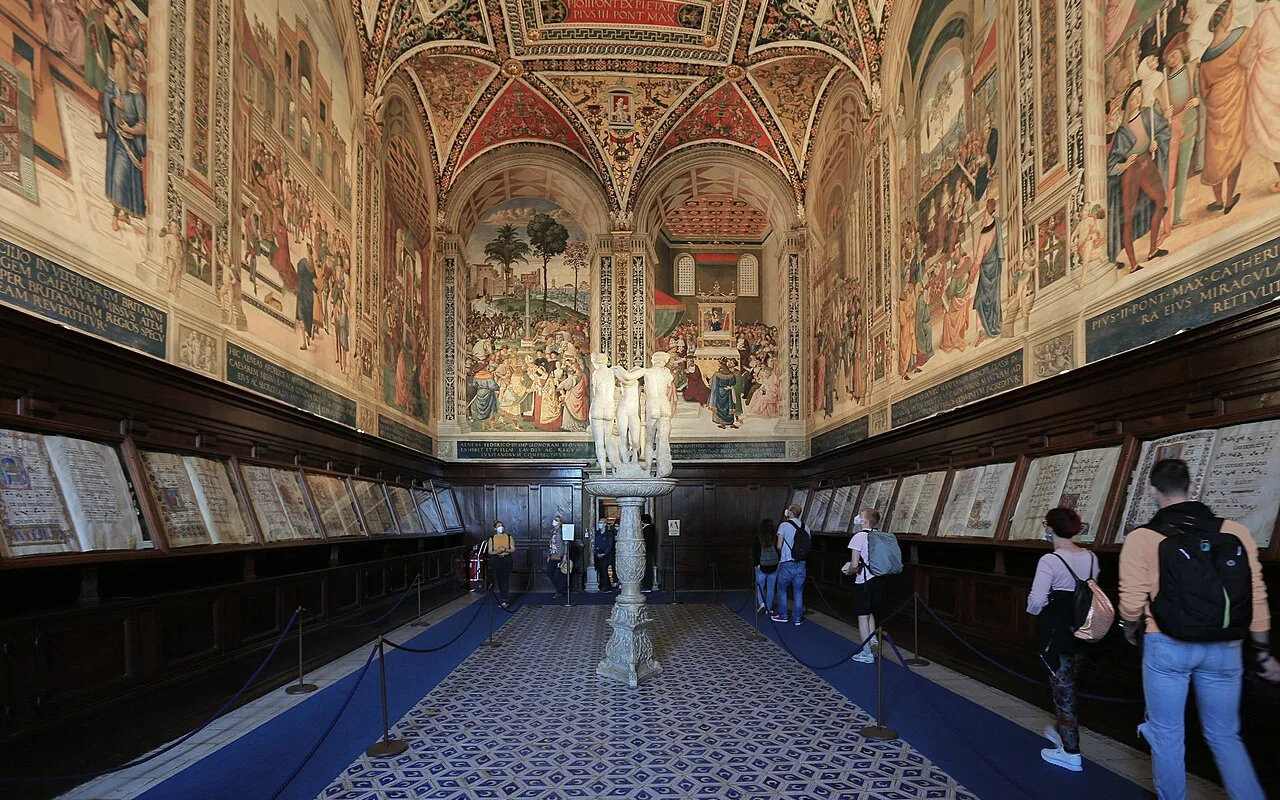
The frescoes cover three of the four walls; the fourth wall is windows. Pinturicchio and his workshop painted ten scenes from the life of Pius II, between 1503 and 1508 by the Opera's own dating. Read them in order around the room. A Latin caption under each scene explains the event. Look for the meeting of Emperor Frederick III and Eleonora of Aragon. In the canonisation of St Catherine of Siena, two figures have long been identified as the young Raphael, in red hose, and Pinturicchio himself.
In the centre of the room stands the Three Graces, a marble group of three women with arms entwined. It is a Roman copy of a Hellenistic original, bought by the cardinal to stand in this room. Then look up. The vault is painted with mythological scenes and bright patterned borders, including Diana and Endymion and the cardinal's coat of arms. The display cases hold 15th-century illuminated choir books, with work by Girolamo da Cremona and Liberale da Verona.
What is in the Crypt under Siena Cathedral?
The Crypt was the last part of the complex to come back into view. Work started in 1999 to recover rooms linked to the Oratory of San Giovannino and San Gennaro. As the digging extended beneath the Cathedral's chancel, it opened onto a painted space nobody had expected to find intact. Medieval records had mentioned a crypt, but scholars did not know how much of it survived. It had been filled with earth and rubble from the early 15th century onwards.
That burial protected the paint. The frescoes date from the second half of the 13th century. The Opera names Guido da Siena, Dietisalvi di Speme, Guido di Graziano and Rinaldo da Siena among the painters. The walls are arranged in two bands: Old Testament stories run along the top and New Testament stories along the bottom. The colour is the surprise. It covers not only the walls but also the columns, capitals and brackets, with geometric and leaf patterns.
Give yourself time to find four scenes the Opera singles out: the Annunciation, the Nativity, the Rest on the Flight into Egypt and the Deposition from the Cross. The Passion of Christ forms the heart of the cycle, with the Crucifixion, the Deposition and the Entombment. These paintings are older than the floor panels and the library frescoes you saw upstairs, so this room holds some of the oldest painting on the whole route.
What to see in the Baptistery of San Giovanni
Unlike Florence or Pisa, Siena never built a separate baptistery. Instead it sits underneath the eastern bays of the Cathedral's choir, beside a monumental staircase. The space was built in the early 14th century and completed around 1325, probably under the master builder Camaino di Crescentino. Inside you find three rib-vaulted aisles, with every vault painted. It feels like a separate church, even though the Cathedral stands directly above you.
The centrepiece is the baptismal font, made between 1417 and 1431 in marble, bronze and enamel. Six gilded bronze panels tell the life of St John the Baptist. Several of the best sculptors of the early Renaissance worked on it, among them Jacopo della Quercia, Lorenzo Ghiberti and Donatello. Walk slowly around all six sides. Find Ghiberti's Baptism of Christ from 1427, cut in very shallow relief. Then find Donatello's Feast of Herod, from the same year, which the Opera calls the most moving scene.
Donatello also made two of the small corner statues, Faith and Hope. Once you have seen the font, raise your eyes to the vault. Vecchietta painted twelve scenes there between 1447 and 1450, illustrating the twelve articles of the Christian creed. Other walls carry scenes by Matteo Lambertini from 1447, the Miracles of St Anthony of Padua by Benvenuto di Giovanni from around 1460, and Pietro di Francesco degli Orioli's Washing of the Feet from 1489.
The Museo dell'Opera: Duccio's Maestà and the New Cathedral panorama
The Museum explains the strangest feature of the square. In 1339 Siena approved a plan to extend its cathedral into a far larger church, with the current building becoming only a part of it. Work went on until 1348, when the Black Death and structural problems stopped it. In 1357 the city ordered the unsound parts demolished. What survives is the huge unfinished façade, the side walls and one aisle. The Museum, founded in 1869, fills the south aisle of that unfinished church.
Go up to the first floor for the main event: Duccio's Maestà, painted between 1308 and 1311. The front shows the Madonna and Child surrounded by more than forty figures. The back tells the Passion of Christ in 26 scenes. Take time with both sides. The museum also holds Duccio's original rose window from the choir, the one you saw as a copy earlier. Here you can stand close to its coloured glass.
The sculpture collection includes Giovanni Pisano's statues of Sibyls, Prophets and Philosophers from 1285 to 1287. They once stood on the Cathedral façade, which today carries copies. Then make the walk up inside the unfinished façade, the Facciatone, to the Panorama. The Opera calls it the most awe-inspiring viewpoint in Siena. It is a fitting last stop, because you end the route standing on the church that was never finished.
Practical tips for the whole complex
Your pass covers all these sites for three consecutive days. On the OPA SI pass, the time printed on your ticket is your Cathedral entry time, and the operator asks you to respect it. The other sites have no fixed slot within those three days. Last admission everywhere is 30 minutes before closing. Opening hours change with the season, and times can shift for religious services, so check the day's hours before you set out.
Each ticket includes a free audio guide that plays on your own smartphone. Bring headphones and a charged battery, since you will use it in every room. If you are doing the roof walk, travel light for the whole day. Backpacks and large bags are not admitted on the roof, and the complex has no left-luggage point. Wear closed, non-slip shoes; high heels are refused on the roof route.
Access varies a lot between sites. The Cathedral has a ramp on its left side. The Museum, the Crypt and the Baptistery have no disabled access. The roof walk starts and ends on a winding staircase, so it is not suitable for wheelchair users. Children up to six go free and are added to your booking at no charge. Your e-ticket arrives by email, so keep it on your phone alongside the audio guide.
Frequently asked
How long does it take to see the whole Siena Cathedral complex?
The Opera della Metropolitana says the OPA SI itinerary takes about two hours. Add 30 minutes for the roof walk, plus the 20 minutes you need at the meeting point beforehand. The pass is valid for three consecutive days, so you can split the route.
Should I do the Gate of Heaven roof walk before or after the Cathedral?
Before is usually easier. You climb while you are fresh, and you see the starred vaults from above before you walk beneath them. Morning roof slots also tend to sell out first, so fix that time and plan the rest around it.
Is the Piccolomini Library a separate ticket?
No. The Library is part of both the OPA SI pass and the combined roof ticket. You enter it from inside the Cathedral, next to the Piccolomini Altar.
Where is the original rose window by Duccio?
The original is in the Museo dell'Opera. The window in the Cathedral's choir today is a copy. Duccio designed the original in the late 1280s, and it measures about six metres across.
Are all parts of the complex wheelchair accessible?
No. The Cathedral has a ramp on its left side, but the Museum, the Crypt and the Baptistery have no disabled access. The roof walk uses a winding staircase.